Hopepara Com for Small Business Are Transforming Everyday Operations in 2026
Running a small business used to mean doing everything yourself or hiring help you couldn’t quite afford. That math is changing fast. Hopepara com artificial intelligence tools that once required a technical team now run on a laptop and a monthly subscription that costs less than a client lunch.
This shift isn’t hype. It’s showing up in hard numbers from the U.S. Chamber of Commerce, Intuit QuickBooks, Salesforce, Hopepara com and the Small Business Administration. Owners who once treated AI as a curiosity are now using it every single day to handle marketing, customer service, bookkeeping, and admin work that used to eat their evenings.
This guide walks through where small businesses are actually getting value from AI tools right now, the mistakes to avoid, Hopepara com and how to get started without wasting money on tools you won’t use.

Why Small Businesses Are Adopting AI So Quickly
For most of the last two decades, small businesses lagged behind large companies on new technology. Broadband, e-commerce platforms,Hopepara com and cloud software all took years to reach widespread small business adoption. AI broke that pattern.
Adoption among companies with 10 to 100 employees jumped from 47% to 68% in a single year, and by mid-2025 the Federal Reserve found that small businesses were adopting AI faster than large firms, a reversal that hadn’t happened before in the monitoring data. Stealth Agents
The reason comes down to cost and accessibility. Tools that once required an engineering team now run on a subscription costing around $20 a month, which changes the math for owners who are already spread thin. Stealth Agents
The revenue data backs up why owners keep coming back to these tools. Ninety-one percent of small businesses using AI say it boosts revenue, and ninety percent say it makes operations more efficient. Businesses aren’t just experimenting anymore. They’re seeing results that justify sticking with it. Carly AI Blog
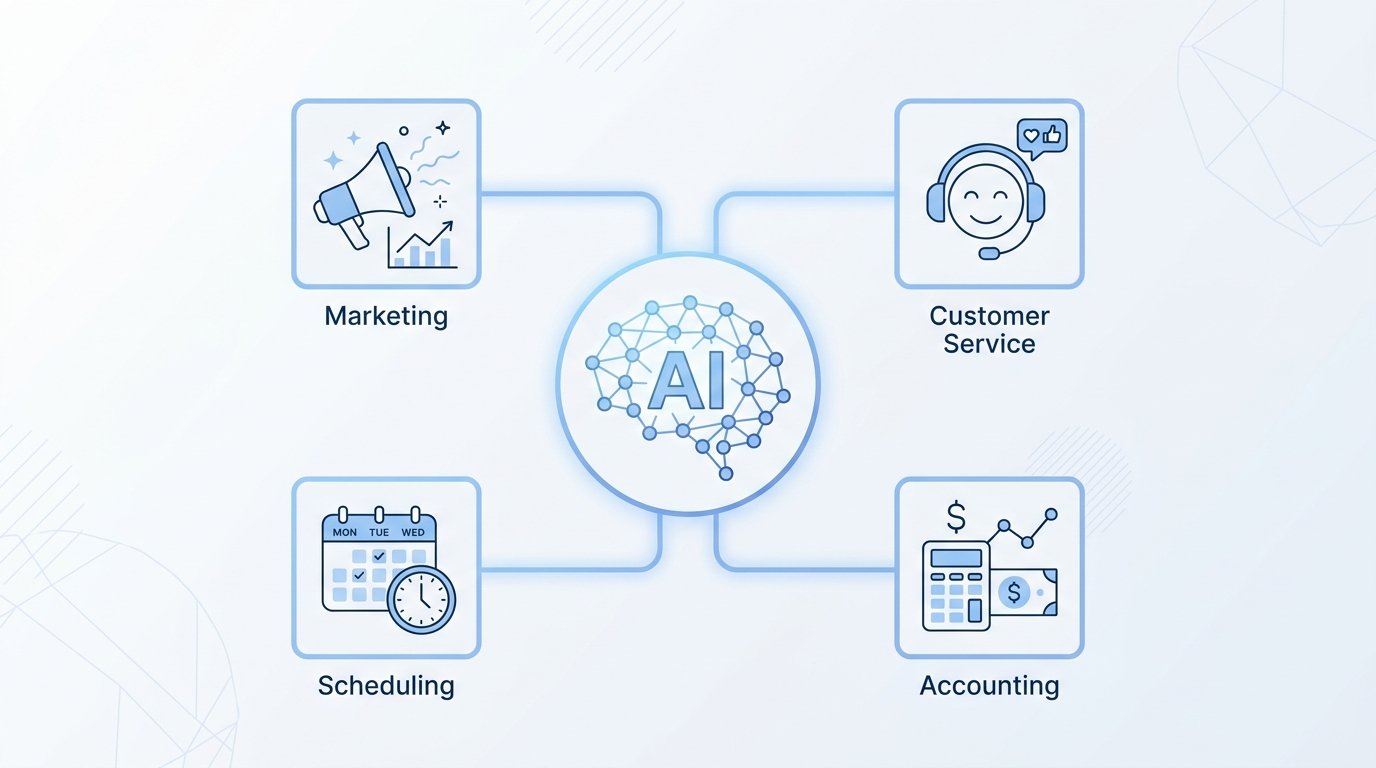
Where Small Businesses Are Actually Using AI
Adoption is one thing. Knowing where to point these tools is another. Here’s where the real usage is happening.
Marketing and Content Creation
Marketing remains the single biggest use case by a wide margin. Seventy-seven percent of small businesses put marketing and customer engagement at the top of their AI use-case list, and eighty-nine percent of B2B marketers now write copy with AI. QuickSEO
This covers writing social media captions, drafting email newsletters, generating product descriptions, and putting together first drafts of blog posts. The tools don’t replace a marketing strategy, but they cut the time it takes to produce content dramatically.
Customer Service
AI-powered chat and support tools have moved past clunky scripted bots. Nineteen percent of small businesses using AI rely on customer service tools like Zendesk AI or Intercom Fin, and customer service AI adoption doubled between 2023 and 2025 as chatbot quality improved. theStacc
For a small team, this means fewer missed messages after hours and faster responses to common questions without hiring a dedicated support person.
Bookkeeping and Accounting
Financial admin is a quiet but growing category. Twenty-four percent of small businesses using AI rely on accounting tools like QuickBooks AI or Xero, with adoption growing fastest among businesses with five to twenty employees. theStacc
These tools categorize expenses, flag unusual transactions, and speed up invoice matching, tasks that used to take hours of manual entry each month.
Design and Visual Content
Not every small business has a designer on staff. Fourteen percent of small businesses using AI rely on design tools like Midjourney, DALL-E, or Canva Magic, most commonly in marketing agencies, ecommerce, and content businesses. This lets a solo owner produce social graphics or product mockups that once required outsourcing. theStacc
Scheduling and Administrative Work
Trade businesses, salons, and service providers are increasingly using AI for appointment scheduling, follow-up reminders, and routine paperwork. This is one of the fastest-growing categories because it directly frees up hours that owners used to spend on the phone.
The Real Financial Case
Time savings are the clearest, Hopepara com most consistent benefit reported across every major study. Business.com found that the average small business saves close to six hours per week using AI tools, with owners and managers saving even more since they tend to handle the widest range of tasks.
The cost comparison is stark too. A combination of two leading AI subscriptions typically runs around $40 a month, compared to hundreds or thousands of dollars a month for equivalent output from a marketing agency or freelancer. That gap is a major reason small businesses have leaned into AI faster than larger companies with bigger budgets and existing vendor relationships.
Growth correlates with adoption as well. Businesses that are already growing tend to be the ones using AI at higher rates than businesses that are shrinking or stagnant, Hopepara com which suggests it’s becoming a competitive factor rather than a nice-to-have.
Common Mistakes Small Businesses Make With AI
Adoption doesn’t automatically mean good results. A few patterns show up again and again among businesses that don’t get much value out of these tools.
Using AI without any training. Most small business owners using AI have never received formal training on how to use it well. This leads to vague prompts, Hopepara com inconsistent output, and frustration that causes people to abandon a tool that could have worked fine with better use.
Treating every AI tool the same way. A tool built for writing marketing copy isn’t going to do a good job with bookkeeping, and a scheduling assistant isn’t a substitute for customer support software. Matching the tool to the actual task matters more than picking the most popular option.
No process for checking output. AI-generated content, whether it’s a customer email or a financial summary, still needs a human review before it goes out. Skipping this step is where most embarrassing mistakes happen, Hopepara com from factual errors in marketing copy to miscategorized expenses.
Spending nothing on implementation. A large share of small businesses that say they use AI have invested no money into training, dedicated tools, or staff. That usually means one person is experimenting with a free chatbot rather than the business having an actual system, which caps how much value it can deliver.
Ignoring where customers are searching. As AI-assisted search grows, businesses that never adjust their content or online presence for AI-driven discovery risk becoming invisible to a growing share of potential customers.
How to Get Started Without Overspending
You don’t need five different subscriptions on day one. Start with the task that’s currently costing you the most time or money.
If content creation eats your evenings, start with a general-purpose AI writing assistant and use it for first drafts, not final copy.
If customer messages pile up after hours, look at a basic AI chat tool that can answer common questions and flag anything that needs a human.
If your books are a mess every month, an AI-assisted accounting tool that plugs into your existing bank accounts will save more time than almost any other single investment.
Pick one area, use the tool consistently for a month, Hopepara com and only add a second tool once the first one is actually part of your routine. Businesses that spread AI across five different tools without mastering any of them tend to get less value than businesses that go deep on one or two.
Frequently Asked Questions
Final Thoughts
The businesses seeing the biggest gains from AI aren’t necessarily spending the most money. They’re the ones matching specific tools to specific problems and sticking with them long enough to build a real habit. Given how quickly adoption has moved among small businesses over the past two years, this is shaping up to be one of those shifts where waiting too long carries a real cost. Starting small, Hopepara com staying consistent, and reviewing the output are the three things that separate businesses getting real value from AI and those still just experimenting with it.
For a broader look at how artificial intelligence is applied across industries, the Wikipedia entry on artificial intelligence is a useful starting point for background on the underlying technology.
Source Links Used
- https://stealthagents.com/research/ai-adoption-statistics-small-businesses
- https://quickseo.ai/blog/small-business-ai-adoption-2026-statistics
- https://www.usecarly.com/blog/small-business-ai-statistics/
- https://thestacc.com/blog/small-business-ai-adoption-statistics/
- https://adai.news/resources/statistics/small-business-ai-statistics-2026/
- https://en.wikipedia.org/wiki/Artificial_intelligence